
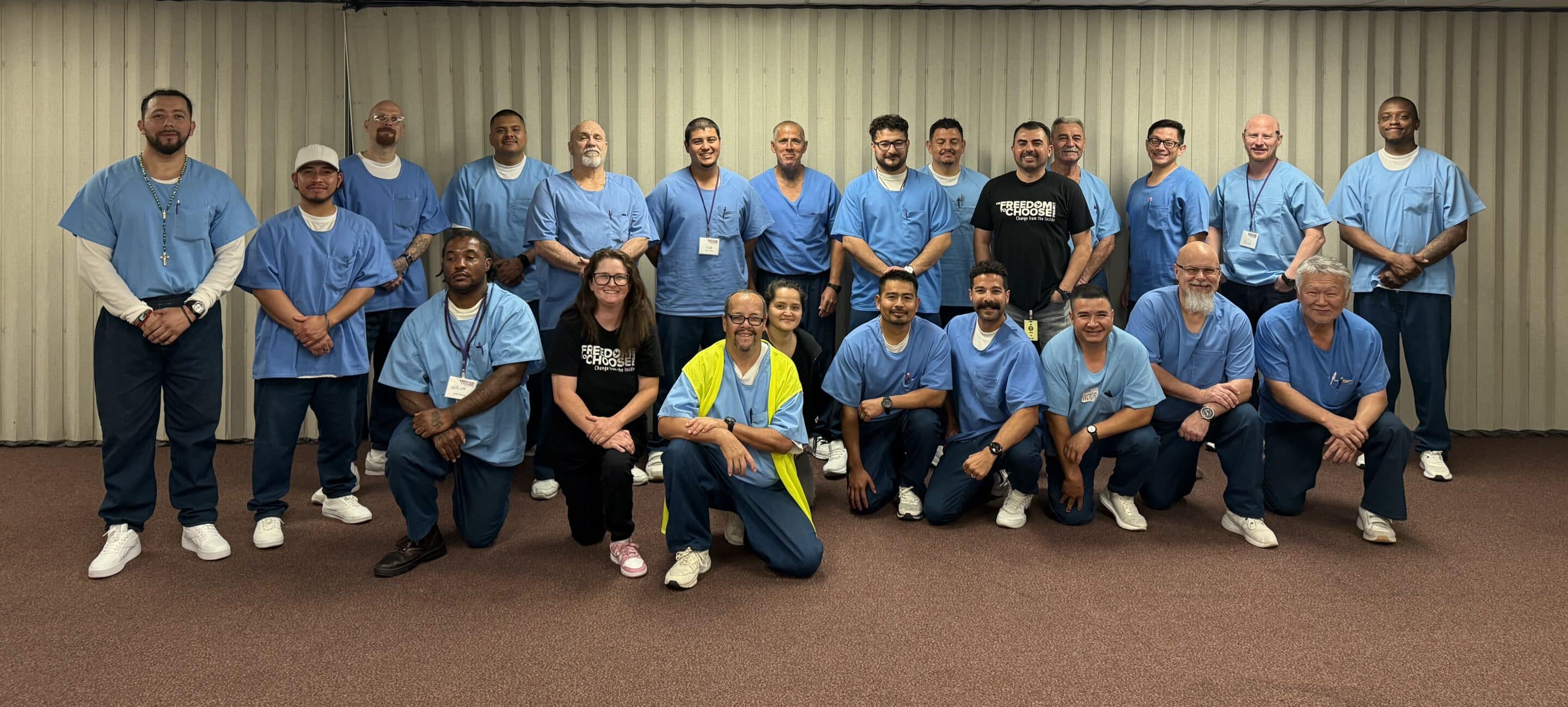
Our program “Excelling in the Workplace” is Transforming Incarcerated Individuals into Community Leaders
There’s a device inside every California state prison that no one wants to think about. It looks like a garage door opener—small, unassuming—clipped to an officer’s belt. But when it’s pressed, sirens wail, lights flash, and every person in the building sits down where they stand.
For years, Eddie Torres dreaded that alarm. Being formerly incarcerated, he knew it all too well and what it represented: a world where choice felt like something that had been taken away.
“You just always dread it,” Eddie shares. “Hopefully it’s never pressed on me. Hopefully there’s never a situation where they have to use it.”
Then one Sunday—less than three years after his release—Eddie found himself back inside a prison. But this time, everything was different.
Now a member of our staff as Education & Project Coordinator, Eddie was serving as Group Lead for the Program Excelling in the Workplace at the California Rehabilitation Center (CRC) in Norco, California.
When a prison staff member had to step out briefly, he handed Eddie the alarm. “Here—in case you need it.”
The same alarm he once feared was now resting in his hand.
“The guys got to laugh,” Eddie remembers. “It just reaffirms that the decision I made [that led me to prison] was never me. It’s a part of my past. It’s not the person I am today.”
That moment—the space between who Eddie was and who he chose to become—is exactly what The Freedom to Choose Project (FTC) is about.
More Than a Job Skills Program
Viktor Frankl wrote that everything can be taken from a person except one thing: the freedom to choose one’s attitude in any given set of circumstances. That idea is the cornerstone of every FTC program, and it’s alive in every session Eddie facilitated.
The Excelling in the Workplace program was designed to meet incarcerated men and women in the questions that weigh heaviest as release approaches: Will I be able to get a jobo with my record? Can I keep it? Do I even know how to navigate the workplace?
Over four cohorts and nine months of Sunday sessions at CRC, Eddie led participants through a curriculum built around emotional intelligence, conflict resolution, self-awareness, and the soft skills that help people not just find work, but grow in it.
Morning and afternoon classes, every single week. The result: a 99% graduation rate.
But the numbers only tell part of the story. The real transformation happened in how participants began to see themselves.
One Person Changes, and Many Others Follow
What sets FTC apart is a belief that transformation ripples outward. One person learns to pause before reacting. They teach others. That person teaches five more.
Eddie saw this firsthand when FTC introduced something new; the lead trainee model. For the first time in the organization’s history, graduating incarcerated participants were invited to become peer leaders. They were given lanyards, name tags, and a role that carried real responsibility.
“I noticed a difference right away,” Eddie shares. “They wore them proudly. Every Sunday, they’d go straight to the trios, anchor the discussions, welcome new volunteers. They took it as a badge of honor.”
The philosophy behind it is simple and powerful. “If I can see [change] in you,” Eddie explains, “I’m more willing to learn, to apply the skills, and to start changing my way of thinking into a new belief system.”
This past cohort marked a milestone that moved everyone: three incarcerated participants led the final group session on their own. It was the first time that had ever happened at FTC.
These men not only graduated from the program, but they also became pillars of their community, giving back even before stepping outside the walls.
Planting Seeds Across California
As CRC prepares to close, those trained leaders will transfer to other institutions and they’ll carry the program with them.
The Excelling in the Workplace curriculum has already expanded to California Men’s Colony (CMC) in San Luis Obispo and the Substance Abuse Treatment Facility (SATF) in Corcoran.
FTC is also developing an all-day leadership training—the first of its kind—at Valley State Prison (VSP). Incarcerated participants will submit cover letters, go through an interview process, and receive training in facilitation, communication, presentations, and organizational leadership. The vision extends to women’s facilities as well.
“Most men and women, all they seek is that opportunity to right the wrongs,” Eddie reflects. “We provide a safe space, the materials and the support. And now, with lead trainees becoming pillars of that community, it’s such a blessing.”
Every seed planted inside those walls grows into something that reaches far beyond them into families, workplaces, and neighborhoods that are stronger because someone was given the tools to choose differently.
One Choice Can Change a Life
Eddie’s story is one of thousands. Since 2004, we have been transforming lives through compassionate, experiential education inside California’s prisons. We help people discover that true freedom isn’t about circumstances. It’s about the choices we make in response to them.
Every graduation, every trained leader, every new facility brings this mission closer to the people who need it most. And every one of those moments is made possible by people who choose to stand behind this work.
Help us expand programs like Excelling in the Workplace and ensure that more people have the chance to come full circle, just like Eddie.
Choose to be part of someone’s transformation. Donate today.